




Stop running your restaurant like it’s the ’90s.

The operating system
for modern
restaurants.

ChefOS brings scheduling, inventory, ordering, reporting, and team workflows into one system your whole restaurant can run from.

ChefOS dashboard on tablet

One platform for every corner of your restaurant.

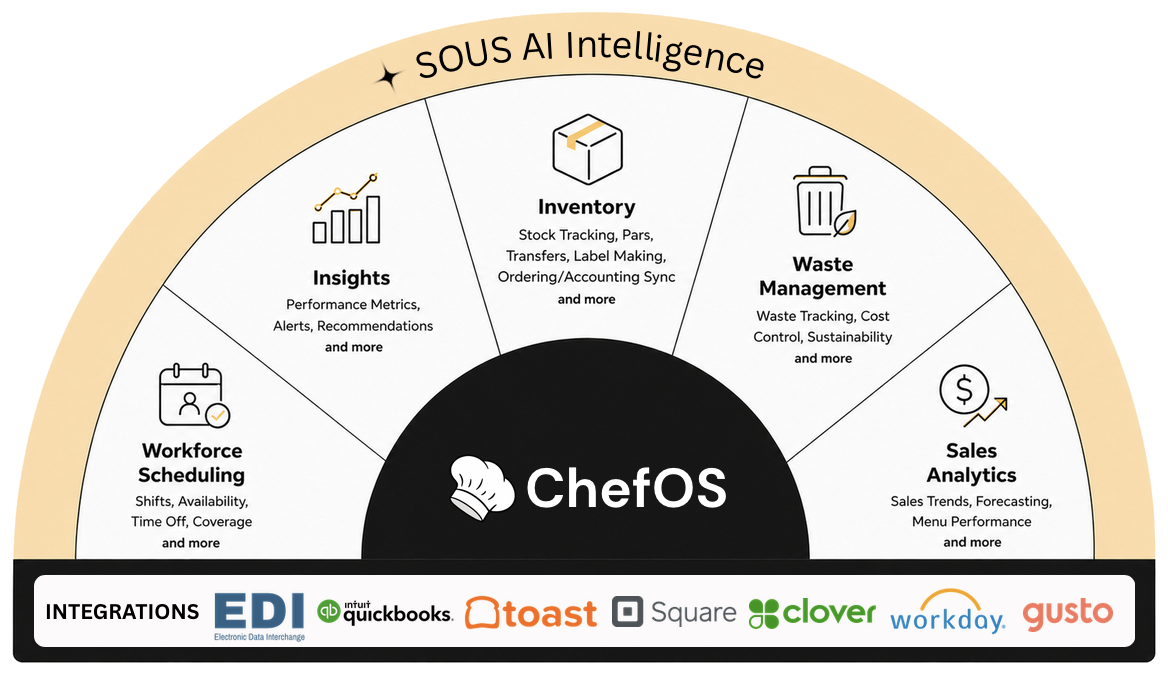
ChefOS unifies the tools you already run into a single operational system — with a shared data layer across scheduling, inventory, sales, and the team on the floor.

ChefOS
ChefOS
Permissions · Automations · Approvals
POS sync · Policies · Audit trail
Scheduling
Shifts · Swaps · Forecasts
Inventory
Pars · Vendors · 86s
Team & Comms
Briefings · Brigade chat
Sales Analytics
POS · P&L · Flash reports
Waste Reduction
Yield · Variance · Shrink
AI Reporting
Plain-English insights

Every surface of the house, in one quiet command.

Every module shares a single data layer — so scheduling knows about sales, inventory knows about waste, and you know everything.

Scheduling

Forecast-aware labor planning, shift trades, compliance — all in one place. Publish schedules in minutes, not hours.

Labor · week of Apr 1228.4% target
M
T
W
T
F
S
S
  • Forecast-based labor targets
  • Auto-balanced shift trades
  • Clock-in drift alerts
  • Payroll exports on autopilot

Inventory

Track waste, yield, and theoretical vs. actual variance with forensic precision. Vendor invoices reconcile themselves.

Halibut
2/6
Duck leg
11/12
Burrata
8/8
Chanterelle
1/4
  • Theoretical vs. actual variance
  • Vendor invoice OCR
  • Prep sheets from forecast
  • 86-list broadcasting

Sales Analytics

Daily reviews take minutes. Board decks write themselves. Sales, labor, and food cost unified in one ledger.

Net sales · today
$18,420
+12.4%
  • Daily flash reports
  • PMix profitability scoring
  • Channel mix attribution
  • Period-over-period variance

Waste Reduction

Identify leaks before they become losses. Track yield by station, shift, and SKU. Turn waste into margin.

Food waste · 6 weeks
−46%
W1W6
  • Yield tracking per station
  • Shrinkage root-cause analysis
  • Menu engineering signals
  • Composting compliance logs

AI Reporting

“Why was food cost high last Tuesday?” Get an answer, a chart, and a recommendation — in seconds.

Why was food cost high last Tuesday?
Halibut over-portioned at station 3 — 12% yield loss vs. spec. Investigate →
  • Natural language queries
  • Automated daily briefings
  • Anomaly detection
  • Board-ready narratives

Team & Comms

Station-scoped channels, shift briefings, announcements with receipts. The back of house and front of house, aligned.

#kitchen4
#floor2
#station-37
#management
  • Station-scoped channels
  • Shift briefings + readbacks
  • Multilingual support
  • Audit trails for compliance

Your AI Copilot For The Entire Operation.

Ask anything in plain English — Sous reads across every module of ChefOS and answers with numbers, charts, and recommended actions. No dashboards to configure, no SQL to write.

Operator using a tablet in a studio

Show me prime cost for this week.

Who's overstaffed on Friday lunch?

Any items at 86 risk?

Make a schedule for week of 04/12.

Prime cost · 7d
61.2%
Driven by halibut — yield down 8% at station 3.

FAQ

Questions operators ask before they switch.

Straight answers on fit, setup, integrations, and rollout.

What does ChefOS replace?

ChefOS replaces the spreadsheets, notebooks, shared docs, standalone inventory tools like FoodPro or CrunchTime, scheduling software, and manual reports built around POS-provided analytics. It does not replace your POS; it powers up the analytics your POS already provides.

Do we need to change our POS?

No. ChefOS is designed to work around your existing POS and operations stack, so your team can keep the systems that already run service.

How long does setup take?

Most teams can launch the first workflows in under two weeks. We configure the system around your menu, vendor setup, locations, and management rhythm.

Is this for single locations or groups?

Both. Single-location teams use ChefOS to tighten daily execution, while multi-unit groups use it to standardize operating rhythm across locations.

What happens after the demo?

If it is a fit, we map your current workflow, connect the right data sources, and start with the highest-leverage operating areas first.